


On a construction site, the rebar bending machine is one of the most frequently used machines. A poorly chosen machine either slows down the work because its capacity is not enough, or wastes money and space because it is larger than necessary. As a company that has been manufacturing rebar bending machines in Balıkesir since 1978, we have gathered in this article the questions we ask our customers before they buy.

1. What is the thickest rebar you use?
The first and most important criterion is capacity. The capacity of a machine shows the diameter of the thickest rebar it can bend. Take the thickest rebar used in your project as a basis and leave a small margin on top of it:
- Detached houses, small buildings, renovation: usually 8–16 mm rebar is used. A portable machine with 18 or 20 mm capacity is sufficient.
- Medium-sized residential projects: 20–24 mm rebar is common in columns and beams. A capacity of 24 or 26 mm allows comfortable work.
- Large construction sites, rebar workshops, infrastructure projects: rebar of 28 mm and above is used. Machines with 36, 42 or 50 mm capacity are preferred.
Running a machine constantly at the limit of its capacity wears out both the motor and the gear group. That is why choosing a model one step above your thickest rebar extends the life of the machine.
2. Will the machine stay in one place or move between sites?
For teams that change sites frequently, a portable rebar bending machine is a great convenience. Afacan R18, R20 and R24 models weigh between 94 and 144 kg and can be carried in a small van. They are suitable for working on formwork or between floors. Our sales records also show that our most preferred rebar bending machine is the portable R20 model. This shows how important portability is on site.

If you will work in a rebar workshop or in a fixed corner of a large site, portability is secondary. What matters here is capacity and the ability to work all day without interruption. Fixed models such as the R36, R42 and R50 are designed for this job.
3. What power supply is on site: 220 V or 380 V?
On many construction sites, especially at the start of the work, only single-phase (220 V) power is available. In this case the machine must be able to run on single phase. Afacan’s R18, R20 and R24 models run on 220 V; the R20 and R24 are also produced as 380 V (three-phase) on request. Models of 26 mm and above run on 380 V three-phase because they require more power.
Check the electrical infrastructure of your site before buying. Running the machine on an unsuitable voltage both strains the motor and creates a safety risk.
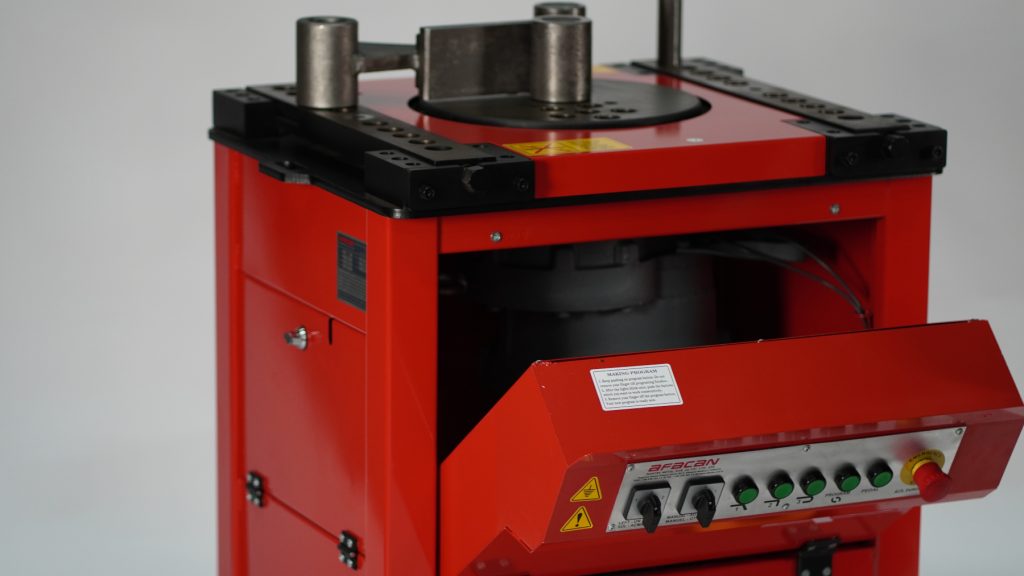
A warning from our service records: long extension cables
The most common issue we encounter in fault reports to our service line is not caused by the machine itself but by the electrical connection . Drive (speed controller) and voltage faults are among the most frequently recorded faults over the last two years. In many of these cases we see that the machine is powered with an extension cable of 40, 60 or even 200 metres.
The longer the cable, the lower the voltage reaching the machine. This causes the drive to give errors, the machine to slow down or stop, and in the long term damages the electronic components. Our recommendations:
- Install the machine as close to the electrical panel as possible and keep the extension cable short.
- If a long distance is unavoidable, use a thick cross-section cable instead of a thin one.
- If you are working with a generator, make sure the generator has sufficient power and that proper grounding is in place.
- Have the phase, neutral and earth connections of extension sockets checked.
4. Which bends will you make?
Rebar bending machines can make bends at different angles such as hooks, L, U and stirrups. When choosing, answer these questions:
- Mostly stirrups, or main reinforcement? If you bend many stirrups from thin rebar, a fast portable model will do the job. Thick main reinforcement requires a powerful fixed machine.
- Will you bend starter bars? Bending starter bars protruding from concrete in place requires a separate solution. Designed for this job, the Afacan HB32 starter bar bending machine bends starter bars up to 32 mm in place.
- How precise must the angle setting be? If you bend many pieces to the same size, an easy and repeatable angle setting saves time.
5. How much rebar will be bent per day?
A machine used occasionally and a machine running from morning to evening have different needs. In intensive use, motor power, gear quality and the durability of electrical parts are decisive. In Afacan machines, electrical and control parts are selected from brands such as Schneider, Siemens, Omron and Leuze. The reason is to reduce the risk of failure under long and heavy site conditions.
6. Warranty, service and spare parts
A rebar bending machine is an investment that will be used for years. Besides price, these questions also matter:
- Does the warranty also cover the motor and electrical parts?
- How quickly does service arrive in case of a fault?
- Are spare parts available immediately, or do they come from abroad?
This is where the biggest advantage of being a domestic manufacturer shows. Afacan Makine provides a warranty on all parts of the product, including the motor and electrical parts. Since production takes place in Balıkesir, you do not wait for parts from abroad for service and spare parts.
Quick summary: which capacity suits whom?
| Your need | Recommended capacity | Afacan model |
|---|---|---|
| Renovation, small buildings, frequent moving | 18–20 mm | R18, R20 |
| Residential projects, columns and beams | 24–26 mm | R24, R26 |
| Large site, rebar workshop | 36–42 mm | R36, R42 |
| Infrastructure, bridges, heavy reinforcement | 50 mm | R50 |
To see the technical specifications of the models side by side, have a look at our article 18 mm or 24 mm? Rebar bending machine models compared .
Can’t decide?
Send us the rebar diameters used in your project and the electrical situation on your site, and let us determine the most suitable model together. You can browse all our rebar bending machines on our Rebar Bending Machine page, or reach us via our WhatsApp line (+90 530 665 60 56) or by phone at +90 266 281 11 30.