


When buying a rebar bending or cutting machine, the first thing usually discussed is the machine’s “size”: an 18 mm, a 24 mm, a 32 mm, a 36 mm machine… Yet there is a practice that has long been taken for granted in the industry, and many buyers are not aware of it. In this article we explain what this practice is, how it can mislead you when comparing prices, and the questions you should always ask when getting a quote.
Is the number in the model name the machine’s real capacity?
There is a long-standing habit in the market: the model name of a machine states a diameter that the machine cannot actually bend or cut. The real capacity of a machine sold as a “24 mm machine” is often about 4 mm lower . This practice is so established that customers also know machines by these names and believe that a “24 mm machine” really processes 24 mm rebar.
A similar situation is seen with motor power. Some machines are offered as “32 mm” or “36 mm” machines but are sold with a lower-powered motor than expected for that class, for example a 2.2 kW motor instead of 3 kW.
How does this affect the buyer?
Since most users never run their machine at full capacity, they do not notice this difference on site right away. The real problem arises when getting a price :
- When you put two different companies’ “24 mm machines” side by side, you may actually not be comparing machines of the same class . The machine that looks cheaper may in fact belong to a lower class.
- On a site working intensively with thick rebar, a machine strained at the limit of its capacity breaks down more often and has a shorter life.
- A machine running with a low-powered motor may not cause problems in the first days, but in long and intensive use it can overheat and lose power.
At Afacan Makine, the model name is the real capacity
At Afacan Makine, we manufacture with a “Real Power, Real Capacity” approach, and we name our rebar bending machine models accordingly. R20 really bends 20 mm and R36 really bends 36 mm reinforcing bar. The number in the model name is the real diameter the machine can process.

| Model | Real capacity | Motor power | Gearbox |
|---|---|---|---|
| R18 | 18 mm | 1.1 kW | Worm gear |
| R20 | 20 mm | 1.5 kW | Worm gear |
| R24 | 24 mm | 2.2 kW | Worm gear |
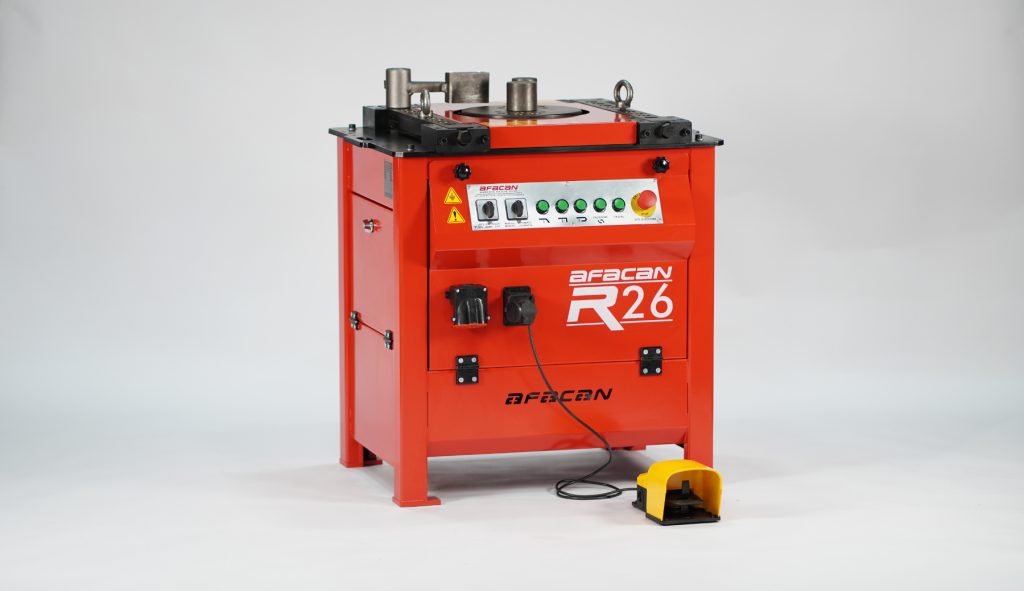
| R26 | 26 mm | 1.5 kW | Helical gear |
| R36 | 36 mm | 3 kW | Helical gear |
| R42 | 42 mm | 4 kW | Helical gear |
| R50 | 50 mm | 5.5 kW | Helical gear |
Motor power alone is not enough: the role of the gearbox
Motor power is an important indicator, but it is not the only factor that determines a machine’s real performance. How efficiently the power produced by the motor is transmitted to the bending disc, in other words the efficiency of the gearbox , is at least as important as motor power.
The difference between worm gearboxes and helical gearboxes
Two types of gearbox are commonly used in rebar bending machines:
- Worm gearbox: Thanks to its small and compact design, it is preferred in light, portable machines. However, due to its working principle, friction between the gears is high; this causes a significant part of the power from the motor to be lost as heat .
- Helical gearbox: Friction losses are much lower. Most of the power produced by the motor is transmitted to the bending disc; as a result, higher bending power is achieved with the same motor power, the gearbox heats up less and withstands long operation better.
At Afacan Makine, the R26, R36, R42 and R50 models do not use worm gearboxes; these models use helical gearboxes . Our portable models such as the R18, R20 and R24, where light weight and portability come first, have worm gearboxes.
A concrete example of this difference is our R26 model: although it uses a 1.5 kW motor, thanks to the high efficiency of its helical gearbox it performs better than a machine with a 2.2 kW motor running on a worm gearbox. So always ask about motor power, but also ask which type of gearbox is used , and consider the real bending capacity of the machine as well when evaluating it.
3 questions you must ask when getting a price
To compare offers correctly, look not at the number in the model name but at the answers to the following questions:
- What is the maximum rebar diameter this machine really bends / cuts? Ask for the machine’s real maximum capacity, not its model name. Compare the thickest rebar in your project with this capacity.
- How long and how intensively will you run the machine on site? A machine that will work all day with thick rebar and one used occasionally have different needs. In intensive use, a machine working at the limit of its capacity wears out quickly.
- What is the machine’s motor power in kW and what type of gearbox does it use? Compare the motor power and gearbox types (worm or helical) of machines offered in the same class. Behind a low price there may be a low-powered motor or an inefficient gearbox.
If you compare prices after getting the answers to these three questions, you will really be comparing machines of the same class.
Quick checklist
- Is the number in the model name the same as the real maximum capacity?
- What is the motor power in kW; single-phase (220 V) or three-phase (380 V)?
- Is the gearbox worm or helical?
- Is the machine suitable for long, intensive operation?
- Does the warranty also cover the motor and electrical parts?
- How quickly are service and spare parts provided?
Questions?
If you are not sure which machine suits your work, tell us the thickest rebar diameter in your project and how intensively you will use the machine; we will recommend the right model based on real capacity. You can browse all our models on our Rebar Bending Machine and Rebar Cutting Machine pages, or reach us via our WhatsApp line (+90 530 665 60 56) or by phone at +90 266 281 11 30.
For other criteria to consider when choosing, see our guides How to Choose a Rebar Bending Machine? and, to see our models side by side, 18 mm or 24 mm? .